London Drama News

London Drama Conference

DramaNow175a_logo

Drama Now! and the Way Ahead - more info and to book


Borough Drama

Is your borough organised for Drama? Does it provide INSET or CPD courses? London Drama can support the development of initiatives and programmes for drama in boroughs. Please contact us if you would like more information. 
Find out more


School Support

If your school would like to develop drama training please contact us. We will advise on or provide active resourcing.


Youth Theatres

Get Into Theatre helps you find out about career opportunities, work experience, training and much more.


New Publications

Drama to Inspire

Drama to Inspire: a London Drama Guide to excellent practice in drama for young people
Edited by John Coventon

This new book is a collection of practice based accounts by fifteen leading practitioners who have had a connection with London Drama, including Dorothy Heathcote, Jonothan Neelands, Andy Kempe and Daniel Shindler.

More info and/or buy here


Order


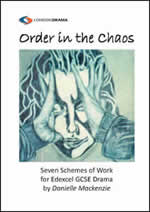
Order in the Chaos
by Danielle Mackenzie

This new practical resource book by Danielle Mackenzie published by London Drama provides teachers with seven exciting units of work and materials designed for the GCSE Edexcel Drama Examintion, New Specification, helping to organise "Order" in all that potential "Chaos".

Published as a downloadable E-Book.

More info and download here


Stanislavski_in_Practice150

Stanislavski in Practice: exercises for students
by Nick O'Brien

This book is an unparalleled step-by-step guide to Stanislavski’s System. Each element of the System is covered practically through studio exercises and jargon-free discussion.

More info and/or buy here


London Drama Members!

Get 5% discount on Drama to Inspire, Order in the Chaos, Stanislavski in Practice and all London Drama books. (Log in required.) Applies also to members of National Drama and English Speaking Board. Find out more

The Independent Review of the Primary Curriculum

The Independent Review of the Primary CurriculumLed by Sir Jim Rose, the final report was published on 30 April 2009. It includes the proposed programmes of learning that would make up a new curriculum and the Essentials for Learning and Life that will be developed throughout the curriculum. A copy of the report can be downloaded from this website by clicking the image left or at the DCSF website at www.dcsf.gov.uk/primarycurriculumreview.

Consultation began on 30 April and closed on 23 July 2009. The feedback will be used by the Government to inform final decisions about the primary curriculum. The consultation can be accessed at the DCSF website at www.dcsf.gov.uk/consultations.

Drama gets a clear mention in several places in the report. In Chapter 1, which is the summary with recommendations, under the heading Cross-curricular studies strengthen subjects we find the following paragraph:

27. Drama is a case in point. It is a powerful arts subject which also enhances children’s language development through role play in the early years and more theatrical work later, which can greatly enrich, say, historical and religious studies as well as personal development by exploring concepts such as empathy. Similarly, dance is a performing art which is equally at home in physical education, and both are enriched by music.

Recommendation 9 states:

Primary schools should make sure that children’s spoken communication is developed intensively within all subjects and for learning across the curriculum. In so doing, schools should capitalise on the powerful contributions of the performing and visual arts, especially role play and drama.

Chapter 3 is Essentials for Learning and Life. There are two paragraphs mentioning drama in the section on Speaking and Listening:

3.16. Although all subjects have potential for developing spoken language, some are particularly valuable in this respect. For example, the appeal to primary children of role play, and drama in its various forms, is often used very successfully to develop speaking and listening and leads to other worthy outcomes.

3.19.To strengthen language development, each programme of learning highlights explicit opportunities for children to develop and apply the full range of literacy skills. In the new curriculum children should learn to develop and apply their speaking and listening skills to suit a variety of audiences and for different purposes. They should tell and listen to stories and explore ideas and opinions in both formal and informal settings. They should have opportunities to express themselves creatively in improvisation.

At the end of the report is Annex B: Programmes of Learning. These pages give guidance to the actual content of the new curriculum.

Under Understanding English, communication and languages, the report states:

Children should read widely for pleasure and learn to become critical readers of an extensive range of texts. An explanatory note states These should include stories, poetry and drama, as well as film, media and multimodal texts which combine words, images and sounds. It also states Children should work with writers, playwrights and poets in and beyond the classroom.

There is a Curriculum Progression section, which gives early, middle and later statements.

In English and Communication - speaking and listening we find the mention of drama and role-play:

E7. to explore the imaginative use of language and the conventions of talk through role-play.
M5. to take different roles and make relevant contributions in group discussion and role-play M8. to convey action, themes and emotions through role-play and drama.
L5. to sustain different roles, deal with disagreement and vary contributions in group discussion.
L8. to identify differences between spoken and written language, both on paper and on screen, taking account of context, purpose and audience.

In Curriculum Development - Understanding the Arts we are told:

This area of learning includes art and design, dance, drama and music and teaches children how to use the arts to express their thoughts and emotions and empathise with others. Through the arts they develop original ideas, explore issues and solve problems.

There are no relevant “Early” statements.

"Middle" M12. to adopt, sustain and develop a range of roles for different purposes
M13. to use and develop a range of dramatic conventions.
M14. to create and perform in order to make and convey meaning.

"Later" L10. to create roles and devise performances that sustain characters, plots and intentions
L11. how facial expressions, body language, movement and space can communicate different emotions and characteristics of behaviour.
L12. to select and experiment with a broad range of drama conventions and forms for different purposes and effects.

It does seem that drama has been given a clear place in this report both as a discrete subject and as a cross-curricular tool. Hopefully this will be retained in the final form of the new curriculum after consultation is completed.

Coming up

DramaNow175a_logo

Drama Now! ~ and the Way Ahead

Thursday 12 & Friday 13 April 2012: All day both days.
Venue: Goldsmiths College, New Cross SE14 6NW
Led by drama/theatre practitioners and young people.

At a time when the arts in education are under increasing challenge, the Conference is designed to inspire and support anyone with an interest in or professional engagement with Educational Drama and Theatre whether in London, or elsewhere.
Our aim is to make links, and put you, the wide range of practitioners, in touch with one another - to share current projects and practice.
Featuring: Cecily O'Neill (keynote), with workshops from:
Adam Annand, Andy Kempe, Daniel Shindler, Lucy Cuthbertson, Paul Sutton.
Performance by Corelli College.
More info and to book here.
Members discount fees here. (Log in needed)


Surveys


Courses Survey

We are always keen to hear what courses we can run for you. Please take our Courses survey here.


Mapping Drama Practice

Take the Survey of Drama Practice: it will only take a minute


Organisations

STEP

STEP is a borough-wide partnership linking the theatre community and education and youth sector in the London Borough of Southwark.
STEP aims to equalise, extend and deepen the theatre and drama experience of all young people living in Southwark through the development of strategic partnerships between schools, youth and community groups and theatres and performing arts organisations.
STEP's objective is to work closely with Southwark schools, youth and community groups and theatres and performing arts organisations to develop creative approaches to learning and provide innovative projects which stimulate children and young people's personal development and contribute to their educational attainment.

Find out more here.